
 GuessPick Team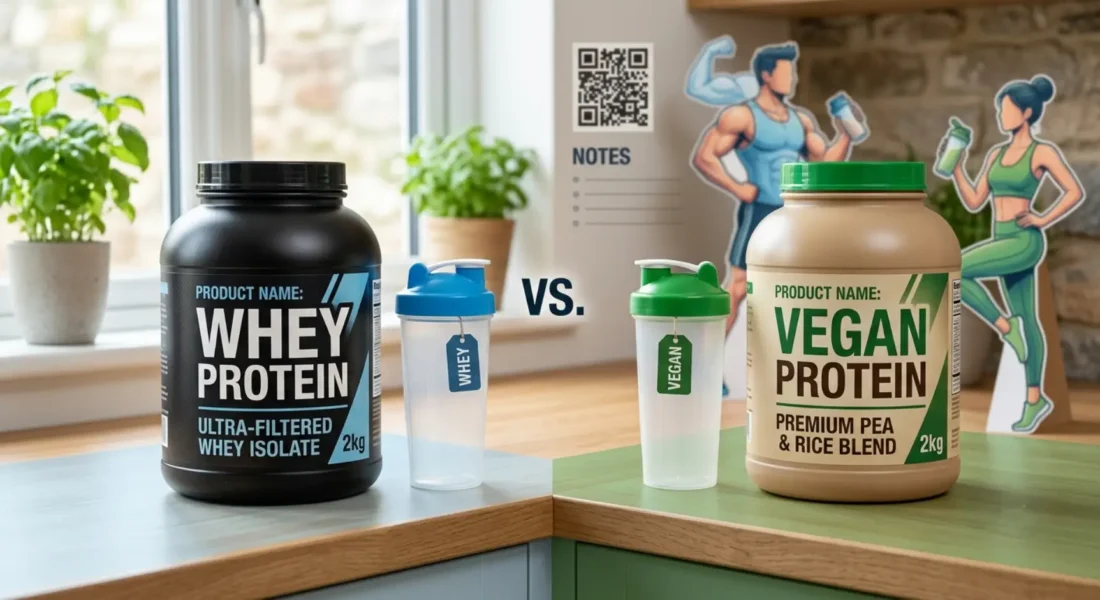
One’s made from milk, the other from plants here’s how they actually compare on muscle growth, digestion, weight loss, and price, so you can stop guessing and start picking.
The honest, no-fluff answer: whey is a great, convenient option if your body handles dairy fine. A good vegan protein can do just as much for muscle growth and recovery, and it’s the better call if you’re avoiding dairy. Neither one is the “winner” it really comes down to your diet, your gut, and your goals.
Quick Comparison for Whey Protein vs Vegan Protein
| Feature | Whey Protein | Vegan Protein |
|---|---|---|
| Made from | Milk | Peas, rice, soy, and other plants |
| Vegan-friendly | No | Yes (if fully plant-based) |
| Lactose | Sometimes, depending on type | None |
| Protein quality | Consistently high | Depends on the source/blend |
| Muscle growth | Works well with enough total protein | Works just as well with enough total protein |
| Digestion | Usually quick, but not for everyone | Depends on the plant source |
| Amino acids | Naturally complete, high in leucine | Varies — blends fill the gaps |
| Taste | Creamy, smooth | Can be earthy or gritty depending on brand |
| Best for | People who tolerate dairy | People avoiding dairy or eating plant-based |
| Price | All over the map | All over the map |
Bottom line: the specific product matters way more than which category it falls into.
What Whey Protein Actually Is
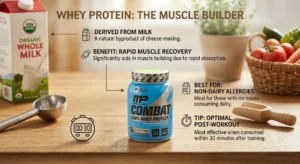
Whey is a byproduct of cheesemaking. When milk gets processed into cheese, it splits into curds and a watery liquid called whey — that liquid gets filtered and dried into the protein powder you scoop into your shaker bottle.
It’s popular for a good reason: whey has all nine essential amino acids and is naturally loaded with leucine, which plays a big role in triggering muscle repair and growth.
The Three Types of Whey
Concentrate: the most affordable version. Still has some lactose, fat, and other milk components in it, so it’s not the leanest option, but it’s budget-friendly.
Isolate: more heavily filtered, so you get more protein per scoop with less lactose and fat. Good if you want something leaner, though it’s still not guaranteed lactose-free.
Hydrolysate” pre-broken-down into smaller fragments, sometimes used in specialty sports products. It’s not automatically “better for muscle” than the other two just processed differently.
Why People Like Whey
- Complete amino acid profile
- High in leucine
- Easy way to boost daily protein
- Backs up muscle growth when paired with training
- Comes in a ton of flavors
- Mixes smoothly
What Vegan Protein Actually Is
Vegan (or plant-based) protein comes from sources like peas, rice, soy, and hemp — no dairy involved at all. That makes it the obvious pick if you’re vegan or just steering clear of milk-based products.
You’ll find it as single-source powders (just pea, just rice) or as blends that combine a few plant proteins to cover each other’s weak spots.
Common Types
Pea protein — usually from yellow peas, a staple in most plant-based blends.
Rice protein — often paired with pea protein since the two complement each other’s amino acid gaps.
Soy protein — actually a complete protein on its own, containing all nine essential amino acids.
Blends — mix and match of the above, with the final nutrition depending entirely on the recipe.
Why People Like Vegan Protein
- Fits a plant-based or dairy-free lifestyle
- Naturally lactose-free
- Still boosts daily protein intake
- Comes in plenty of flavors and formats
- A solid fallback if dairy doesn’t agree with you
- Supports muscle growth just as well, given enough protein overall
Is Either One Right for You?
Consider whey if
- You already eat dairy comfortably
- You want something convenient post-workout
- You like the taste and texture
Consider vegan if
- You’re plant-based or dairy-free
- You don’t want milk-derived ingredients
- Whey doesn’t sit well with you
Skip whey entirely if you have a milk-protein allergy. And remember: “plant-based” doesn’t automatically mean “easy on the stomach” — some vegan powders pack in sugar alcohols or added fiber that can cause bloating just as easily as dairy can.
Which Builds More Muscle?
Honestly? Neither has a clear edge. Muscle growth comes down to training hard, eating enough protein and calories overall, sleeping well, and staying consistent the powder is just a supplement, not the main event.
Whey’s advantage is that it’s naturally complete and rich in leucine, and it digests fast. But “digests fast” doesn’t mean “builds muscle faster” — that’s a myth worth dropping.
Vegan protein absolutely can build muscle too, as long as you’re eating enough total protein and picking a product with a solid amino acid spread (blends usually handle this better than single-source powders).
The real verdict: whey is convenient if you tolerate dairy, but a well-made vegan blend is not a downgrade. Your total daily protein and gym consistency matter far more than which tub you’re scooping from.
Which Is Easier to Digest?
There’s no universal winner here it’s genuinely about your own body.
Whey can cause bloating, gas, or discomfort in some people, usually tied to lactose or a milk-protein sensitivity. Isolate tends to be gentler than concentrate since it has less lactose, but it’s not a guarantee.
Vegan protein is naturally lactose-free, which helps if dairy is your issue. But pea protein, soy, or blends with added fiber and sweeteners can still cause their own bloating for some people.
| Your situation | What to try | |
|---|---|---|
| Dairy sits fine with you | Whey works | |
| Lactose is the problem | Go low-lactose or vegan | |
| You avoid dairy altogether | Vegan protein | |
| Milk-protein allergy | Skip whey entirely | |
| Plant protein bloats you | Try a different formulation or smaller serving | |
The takeaway: pick whatever your gut actually tolerates. Neither type gets an automatic pass on digestion.
Which Is Better for Weight Loss?
Here’s a common myth: people assume vegan protein is automatically better for losing weight just because it’s plant-based. That’s not really true.
Weight loss comes down to staying in a calorie deficit over time. Protein helps you feel full and hang onto muscle while you’re cutting calories, but the source of that protein isn’t the deciding factor.
What actually matters when comparing products:
- Calories per serving
- Protein per serving
- Added sugar
- Fat content
- How well it fits your daily calorie budget
Some vegan powders have more fiber; some whey products have fewer calories per scoop — but this varies product by product, not category by category. Pick whichever fits your calorie goals and your dietary preferences.
Amino Acids: Does One Really Win?
Your body needs nine essential amino acids it can’t make on its own, and this is where whey and vegan protein genuinely differ a bit.
Whey naturally has all nine, plus a strong dose of leucine — which is why it’s often called a “complete” high-quality protein.
Vegan protein depends entirely on the source. Pea and rice each have different strengths and weaknesses, which is why they’re so often combined. Soy, on the other hand, is a complete protein all by itself.
When shopping for vegan protein, check: what’s the actual source, how much protein per serving, is it a blend, and does the label share amino acid info. A plant protein isn’t automatically weaker — the formulation is what decides that, not the plant-vs-animal label.
Which Gives You More for Your Money?
Don’t just compare the price tag on two tubs — that’s misleading. A cheaper tub might have way less protein per scoop, making it actually more expensive per gram of protein.
Instead, compare: total pack size, protein per serving, number of servings, price per serving, and the number that actually matters cost per gram of protein.
Quick example: Say a tub costs ₹2,000 for 1,000g of powder, and each 30g scoop gives you 24g of protein. That’s about 33 servings, roughly 800g of actual protein in the tub working out to around ₹62.50 per 25g of protein.
Whey isn’t automatically cheaper than vegan protein, or vice versa cheap and premium options exist in both categories. Always do the per-gram-of-protein math before deciding.
How to Actually Pick One
1. Think about your diet. Dairy sits fine with you? Whey’s an option. Vegan or dairy-free? Go plant-based. Milk allergy? Whey’s off the table completely.
2. Think about your goal. Building muscle — both work, just hit your daily protein target consistently. Losing weight — compare calories, protein, and serving size, then pick what fits your calorie budget. General fitness you might not even need a protein powder if your regular diet already covers it.
3. Pick the right type within your category. Whey concentrate for budget, isolate for less lactose and more protein per scoop. For vegan, blends usually beat single-source powders for a rounder amino acid profile.
4. Actually read the label. Protein per serving, serving size, calories, added sugar, allergens, and any real (not just decorative) quality certifications.
5. Don’t ignore taste and how your gut feels. A protein powder only works if you can actually stomach it and stick with it. If something’s causing discomfort, try a smaller serving or a different formulation before giving up on the category entirely.
looking for more fitness and nutrition comparisons? Explore our latest fitness guides to make better choices for your health and fitness goals.
FAQs: about Whey Protein vs Vegan Protein
Is vegan protein as good as whey for building muscle?
Yes as long as you’re eating enough total protein and training properly, a good vegan protein gets the job done.
Which is better for beginners?
Either. Base it on your diet, digestion, and budget rather than which one’s “supposedly” better.
Can I switch from whey to vegan protein?
Sure, anytime. Just check the protein content per serving so you’re not accidentally shortchanging yourself.
Is vegan protein better for lactose intolerance?
It’s naturally lactose-free when made purely from plants, so yes — but always double-check the full ingredient list.
Does vegan protein have all the essential amino acids?
Depends on the source. Soy does on its own; other single-source plant proteins don’t, which is why blends exist.
Can people with a milk allergy use whey?
No — skip it and find a suitable alternative.
Is whey better right after a workout?
It digests fast and delivers amino acids quickly, but you don’t need to chug it the second you finish your set. Vegan protein supports recovery just fine too.
Will I lose muscle if I stop taking whey?
Not automatically. Keep training and eating enough protein from regular food, and you’ll hold onto your gains.
Is vegan protein better for weight loss?
Not automatically — compare calories and protein content per serving rather than assuming the plant-based one wins.
Does soy protein lower testosterone in men?
No solid evidence supports that for normal amounts of soy protein.
Can whey damage healthy kidneys?
Not for people with healthy kidneys eating a reasonable amount. If you have kidney disease, talk to a doctor first.
Why does vegan protein sometimes taste different?
Plant proteins can be earthier or grittier depending on the source, while whey tends to be creamier — but this varies a lot by brand and flavor.
The Final Word
Both whey and vegan protein can genuinely support your fitness goals — there’s no universal “better” one. It comes down to whether you tolerate dairy, what you eat, how your gut reacts, and what you’re actually trying to achieve.
If dairy agrees with you, whey is a convenient, well-studied option. If you’re plant-based or avoiding dairy, a well-formulated vegan blend can absolutely keep up in terms of muscle growth and recovery.
Before you buy anything, check the protein content, ingredients, serving size, and price per gram of protein — that’s what actually separates a good product from a bad one, not the category it belongs to.
Stop guessing. Start picking.
Want to explore protein supplements from trusted brands? Check out MuscleBlaze and Nutrabay to compare protein products, ingredients, and prices.



Sign in to share your opinion
Sign in with Google