
 GuessPick Team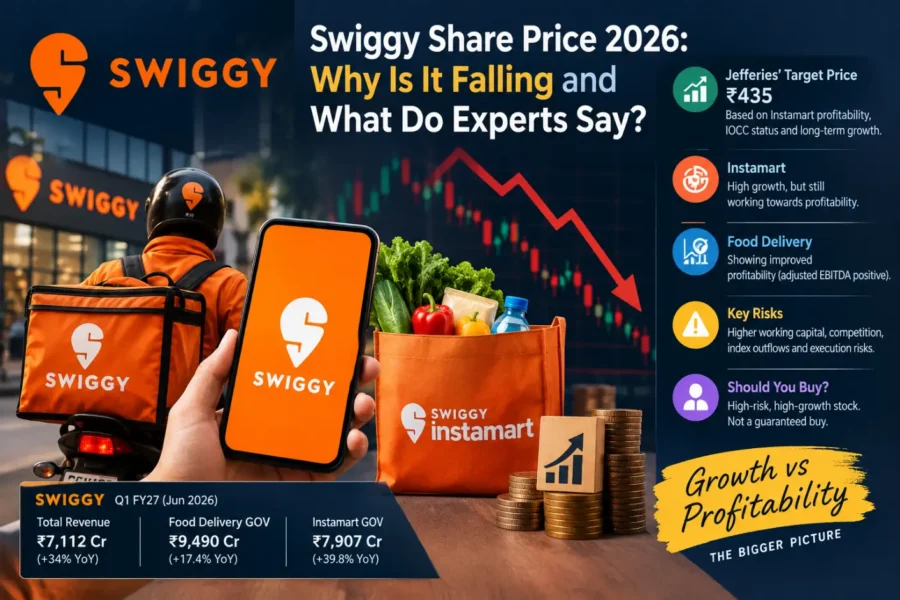
Search Intent: People searching this want to know if Swiggy stock can hit ₹435 in 2026, what top brokerages are predicting, and whether Instamart can turn profitable. They want a clear, no-fluff view before deciding to buy or hold.
Note: Analyst targets are educated guesses, not promises. Swiggy’s actual price will depend on its results, competition, and how the market feels about growth stocks in general.
Quick Answer
There’s no single “correct” target for Swiggy in 2026. Here’s what major brokerages have said recently:
| Brokerage / Analyst | Target Price | View |
|---|---|---|
| JPMorgan | ₹360 | Buy |
| BNP Paribas Exane | ₹390 | Buy |
| Axis Capital | ₹410 | Buy |
| Jefferies / Nomura-Instinet | ₹435 | Buy |
| ICICI Securities | ₹520 | Buy |
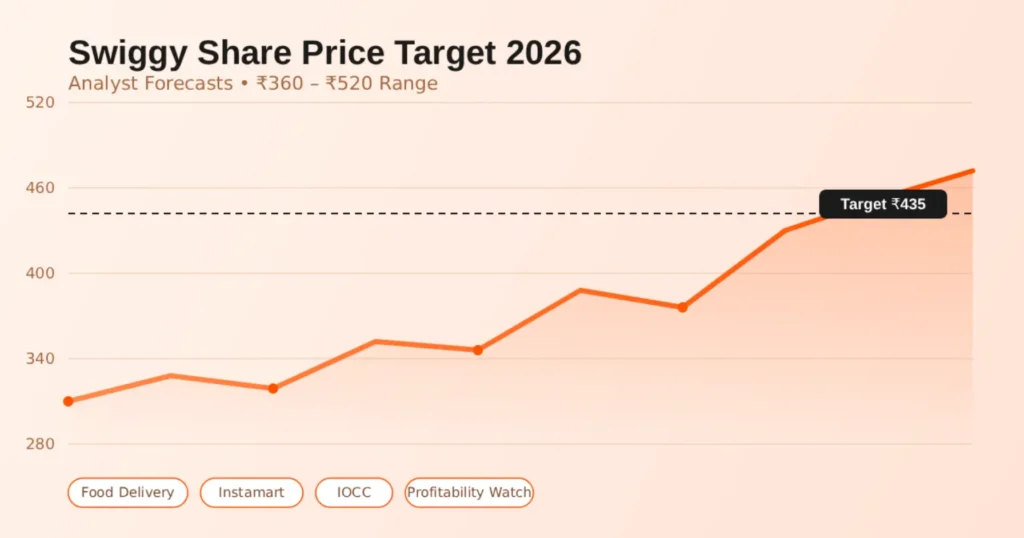
The full range analysts are using runs from about ₹230 to ₹520. That’s a big gap. It tells you how uncertain the market still is about Swiggy’s future.
Instead of fixating on ₹435, it’s more useful to understand what would actually push the stock toward the top or bottom of that range.
Swiggy Share Price Today
A price printed in an article goes stale fast. Swiggy’s stock moves every day.
If you’re tracking it seriously, check these instead of a fixed number:
- Current share price
- 52-week high and low
- Trading volume
- Average analyst target
- Latest quarterly results
- Food-delivery margins
- Instamart’s contribution margin
- Overall progress toward profitability
The stock has spent a good chunk of 2026 well below its 52-week high. That shows how quickly sentiment shifts when profitability expectations change.
What Each Brokerage Is Saying
JPMorgan: ₹360
JPMorgan is bullish, but cautious. Their ₹360 target factors in Swiggy’s growth along with how much cash the company still needs to invest.
BNP Paribas Exane: ₹390
This target assumes Swiggy keeps improving its operations as the business scales up.
Axis Capital: ₹410
Crossing ₹400 signals real confidence — Axis sees meaningful upside if Swiggy delivers on both growth and margins.
Jefferies / Nomura-Instinet: ₹435
This is the target getting the most attention, mainly because it sat well above Swiggy’s trading price when it was announced. The case rests on Instamart’s improving economics and Swiggy’s move to become an Indian-Owned and Controlled Company (IOCC).
ICICI Securities: ₹520
The most bullish call on the table. It’s a reminder that no single target should be treated as gospel — look at the range, not one number.
Can Swiggy Actually Reach ₹435?
Yes, it’s possible. But it won’t happen just because revenue grows. The stock needs real progress on:
- Food-delivery profitability
- Instamart’s contribution margins
- Quick-commerce unit economics
- Overall losses coming down
- Customer and order growth
- Cash flow
- Competitive position
If margins improve faster than expected, the stock could re-rate higher. If losses stay high, or competitors force Swiggy to spend more, the market will likely stay cautious.
Bottom line: ₹435 is a scenario, not a guarantee.
Why Is the Stock Under Pressure?
Quick commerce needs cash. Instamart’s dark-store expansion and delivery infrastructure aren’t cheap.
Profitability is patchy. Some segments are doing well. The company as a whole still isn’t.
Competition is brutal. Blinkit, Zepto, and other big players keep the discounting war going, which eats into margins.
Valuation runs on expectations. If the market thinks future growth will be weaker than hoped, the stock falls — even if the business is still growing.
Broader market mood matters too. A weak market for growth stocks drags Swiggy down regardless of how the business itself is doing.
Can Instamart Make Swiggy Profitable?
This is the story to watch.
In Q1 FY27, Instamart’s GOV hit roughly ₹7,907 crore — about 40% growth year-over-year. Its contribution margin improved to around -0.2%, which is close to breakeven.
Investors don’t just want growth here. They want proof it’s becoming sustainable.
Swiggy has big long-term ambitions for Instamart. If order density keeps rising and monetisation improves, this could become the main driver of the stock’s future value.
The flip side: more stores mean more capital tied up, and competitors aren’t backing off.
What Does Swiggy’s IOCC Status Mean?
Swiggy is working to become an Indian-Owned and Controlled Company (IOCC). This lets Instamart shift from a marketplace model to an inventory-led one.
Marketplace model: Swiggy connects buyers and sellers, nothing more.
Inventory-led model: Swiggy controls inventory, pricing, and procurement directly.
Potential upside:
- Tighter inventory control
- Better purchasing power
- Smoother supply chain
- Room for margin improvement
- More control over product range
Potential downside:
- Needs more working capital
- Inventory risk
- More operational complexity
- Execution risk
This shift could help Swiggy’s margins. But it’s not automatic — wait for the numbers to confirm it before assuming it’s a win.
Is Swiggy Still Losing Money?
Depends on which part of the business you’re looking at.
Food Delivery: Getting stronger. Q1 FY27 adjusted EBITDA came in around ₹292 crore. Scale is finally translating into real margin.
Instamart: Still investment-heavy. Margins are improving, but quick commerce is an expensive game to be in.
So don’t paint Swiggy with one brush — look at each segment on its own.
Bull, Base, and Bear Cases
Bear case: Instamart losses stay high, competition intensifies, customer acquisition gets pricier, and profitability keeps slipping further away. Result: lower valuation.
Base case: Food delivery keeps growing steadily, Instamart edges closer to breakeven, and expansion stays controlled. This puts Swiggy somewhere in the middle of the analyst range.
Bull case: Instamart margins improve faster than expected, food delivery stays strong, losses shrink, and the inventory-led model works well. This is the scenario where ₹435 or higher starts looking realistic.
These aren’t predictions — think of them as a way to track what actually matters.
Swiggy vs Eternal (Zomato): Which One’s Better?
Both companies play in food delivery and quick commerce, but they’re not the same bet.
| Factor | Swiggy | Eternal |
|---|---|---|
| Food delivery | Major business | Major business |
| Quick commerce | Instamart | Blinkit |
| Profitability | Improving | More mature |
| Growth potential | High | High |
| Competition | Strong | Strong |
| Key question | Path to profitability | Sustaining growth and margins |
A cheaper share price doesn’t mean a cheaper stock. Compare valuation and growth expectations, not just the sticker price.
What Could Push the Price Higher?
- Food-delivery margins keep improving alongside healthy order growth
- Instamart hits sustainable profitability
- Ads, memberships, and other monetisation kick in
- Consolidated losses shrink consistently
- The inventory-led model works without draining cash
What Could Push the Price Lower?
- Quick-commerce rivals force heavier spending
- Profitability takes longer than expected
- The inventory-led model eats up more working capital than planned
- A broader correction hits growth and tech stocks
- Execution slips across Swiggy’s many moving parts
Should You Buy Swiggy Shares?
There’s no clean yes or no here.
Swiggy is a high-growth, higher-risk stock. Its future value depends heavily on whether it can grow and get profitable at the same time.
Keep an eye on:
- Quarterly revenue growth
- Food-delivery margins
- Instamart’s GOV and contribution margin
- Adjusted EBITDA
- Consolidated losses and cash flow
- Dark-store expansion
- IOCC developments
If you want lower risk, this stock might not be for you. If you’re fine with volatility for a shot at long-term upside, it’s worth watching closely.
Don’t buy just because of the ₹435 headline number.
For Short-Term Investors
Watch quarterly results, target revisions, Instamart margin updates, price momentum, volume, and any major announcements.
For Long-Term Investors
Ask yourself:
- Can Swiggy become consistently profitable?
- Can Instamart hit sustainable EBITDA profitability?
- Can food delivery keep growing at a healthy pace?
- Can cash burn come down?
- Can the inventory-led model actually improve margins?
These questions matter more than any single day’s stock price.
Final Verdict
Swiggy’s 2026 story comes down to one tension: growth versus profitability.
The growth opportunity in food delivery and quick commerce is real. So is the amount of cash needed to fund it.
Analyst targets range from ₹360 to ₹520, with ₹435 as the number to watch. But nothing guarantees Swiggy gets there.
The good news: food delivery is turning profitable, and Instamart’s margins are improving.
The risk: competition, capital needs, and slower-than-hoped profitability.
Bullish view: Strong growth plus improving margins plus Instamart turning profitable = higher valuation.
Neutral view: Growth continues, margins improve slowly, stock stays choppy.
Bearish view: Heavy competition and ongoing losses keep the stock under pressure.
The real question isn’t “Will Swiggy hit ₹435?” It’s “Is Swiggy’s business improving fast enough to deserve a higher price?” The next few quarters will answer that.
FAQs: Swiggy Share Price Target
Q. What is the Swiggy share price target for 2026?
There’s no single agreed target. Recent brokerage estimates range from ₹360 to ₹520.
Q. What is Jefferies’ target for Swiggy?
₹435. It’s an estimate, not a promise.
Q. Can Swiggy reach ₹435?
Possibly — if growth and margins improve enough. It could also stay below that if losses or competition stay high.
Q. Is Swiggy profitable?
Food delivery is showing adjusted EBITDA profits. Instamart is still investing heavily, though its margins are improving.
Q. Why does Instamart matter so much?
It’s Swiggy’s biggest growth lever. How it performs will shape the company’s overall valuation.
Q. What’s the biggest risk for Swiggy?
Quick-commerce competition. It could force more spending and delay profitability.
Q. Is Swiggy good for long-term investors?
Only if you’re comfortable with risk and believe in the long-term growth story. Check valuation and competition before deciding.
Q. Swiggy vs Eternal which is better?
Depends on your risk tolerance and what you value more: Swiggy’s growth path or Eternal’s more mature profitability.
Q. What should I track before investing in Swiggy?
Quarterly results, food-delivery margins, Instamart’s contribution margin, losses, cash flow, and competition.
This article is for information only. It’s not investment advice. Stock prices and analyst targets change often — do your own research and consider talking to a SEBI-registered investment adviser before investing.

Sign in to share your opinion
Sign in with Google