
 Daniel Pryke
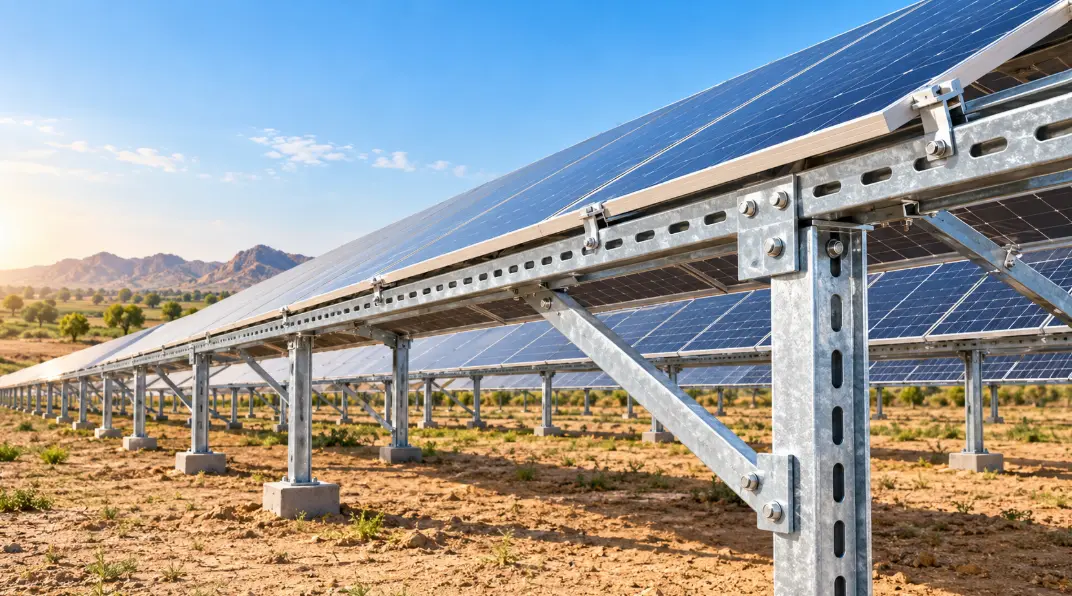
Quick answer: Check seven things before you order. Ask about the steel and zinc coating, the wind-load calculation for your site, test reports, product fit, delivery time, warranty terms, and the full quote. If a manufacturer cannot show paperwork for these, move on.
Panels get all the attention. The structure underneath often gets one phone call and a price per kg. That is risky, because the frame has to hold your panels steady for 25 years. If it rusts or bends in year seven, you pay to remove the panels and fix it.
So here is a simple checklist. It works for rooftop owners, farmers and EPC contractors.
1. Check the steel and the coating
- First, ask what the structure is made of. Most Indian buyers pick galvanised steel, but the coating method matters.
- Hot-dip galvanised: the maker dips finished steel in molten zinc. It suits ground mounts and dusty or coastal sites.
- Pre-galvanised: zinc goes on at the mill, before cutting. It suits lighter rooftop frames in mild areas.
Painted mild steel: paint only. It works for short-term use with regular repainting. - Hot-dip galvanising also covers cut edges and drilled holes. Pre-galvanised steel leaves those spots bare, so rust starts there.
Next, ask for the zinc thickness in microns. A common benchmark is 85 to 100 microns for inland sites and 120 or more near the coast. However, the right figure depends on your site and project specification, so confirm it with your engineer.
Finally, ask for the mill test certificate (MTC). It proves the steel grade. Public tenders often name IS 2062 for the steel and IS 4759 for the zinc coating.
2. Ask for a wind-load calculation for your site
Wind causes most structural failures. In India, designers follow IS 875 Part 3 for wind and IS 1893 for earthquake zones. A generic catalogue drawing does not cover your site.
Instead, ask for a calculation that uses your district’s wind speed and terrain. It should show the assumed loads, the safety factor and the section sizes. For commercial projects, ask for a stamp from a registered structural engineer.
Local conditions matter too. In Rajasthan, open farmland and dust storms (locally called andhi) put real pressure on ground-mounted frames. For comparison, one public tender for a 3.5 MWp plant asked for 150 km/h wind resistance.
3. Verify certificates and test reports
An ISO 9001 certificate shows that a quality system exists. It does not prove that your structure is strong. Therefore, ask for product-level proof as well:
- A coating thickness report from finished pieces
- Test reports from a NABL-accredited or third-party lab, where available
- Approved drawings for your project
Also check the certificate itself. The company name, validity date and scope should match the factory that will make your order. Better still, ask for a coating gauge reading on a finished piece. It takes seconds.
4. Match the product to your project
Not every structure suits every job. Because of this, ask which sections the manufacturer actually makes.
- C-channel: forms the main frame of most mounting structures.
- Unistud (slotted channel): allows flexible, modular assembly.
- Rooftop or ground mount: an RCC roof, a metal sheet roof and an open field need different designs.
For farm and ground-mounted projects, also read the requirements on the official PM-KUSUM portal. Then confirm that the rails and clamps fit your panel frame. If you need a custom size, ask for a sample before you place the full order.
5. Check capacity, lead time and delivery
A late structure holds up the whole plant. So ask these questions:
- What is your monthly output?
- Do you galvanise in-house or outsource it?
- How long will my quantity take?
- How do you dispatch to my state, and who pays for transport?
Outsourced galvanising is not a problem by itself. However, it adds a step, so ask who does the work and request their reports.
6. Read the warranty and after-sales terms
A warranty of 10 years or more against corrosion is common. Still, the exclusions matter more than the headline number. Watch for vague clauses that let the maker cancel cover after any storm or “improper installation”.
Also ask what support comes with the order. Good suppliers share installation drawings and a manual, and they keep spare clamps and bolts. In short, you want to know who answers the phone in year five.
7. Compare quotes on the same basis
Quotes arrive per kg, per metre or per kW. Those numbers cannot be compared directly. So ask every supplier for the same details:
- Total weight and steel thickness
- Zinc coating in microns
- What is included (bolts, clamps, foundation parts)
- Transport and GST
Then divide each total by the weight to get a price per kg, and by the system size to get a price per kW. Now the quotes line up.
Watch for red flags too. A price far below the others usually means thinner steel, a thinner coating or both. Likewise, missing documents and no reference sites are warning signs. Ask for two or three completed projects of a similar size, and visit one if you can.
Documents to ask for before you pay
- Mill test certificate for the steel
- Zinc coating thickness report
- Wind-load calculation for your site
- ISO certificate and any lab test reports
- Written warranty with exclusions
A note on Surya Kiran Fabricators
Disclosure: I handle digital marketing for Surya Kiran Fabricators, so treat this as one option among many. The company in Sri Ganganagar makes C-Channel and Unistud structures, lists an ISO certification and supplies across India. If you shortlist them, run the same seven checks. They should pass these like anyone else.
FAQ
What matters most when choosing a solar structure manufacturer?
The zinc coating and the wind-load calculation matter most. A weak coating rusts early, and a weak design fails in a storm.
How thick should the galvanised coating be?
For inland sites, 85 to 100 microns is a common benchmark. Near the coast, buyers often ask for 120 microns or more. Confirm the exact figure with your engineer.
What is the difference between C-channel and Unistud?
C-channel is structural steel used for the main frame. Unistud is a slotted channel that supports flexible, modular assembly.
Can I order from a manufacturer in another state?
Yes, many manufacturers dispatch across India. Ask about transport cost and lead time before you confirm.
Sign in to share your opinion
Sign in with Google