 Prince Kumar
If you run a US business today, you have probably been pitched “AI transformation” more times than you can count. Every agency now claims to build chatbots, agents, and copilots. Far fewer can put a system into production, connect it to the software you already run, and keep it secure and useful a year later.
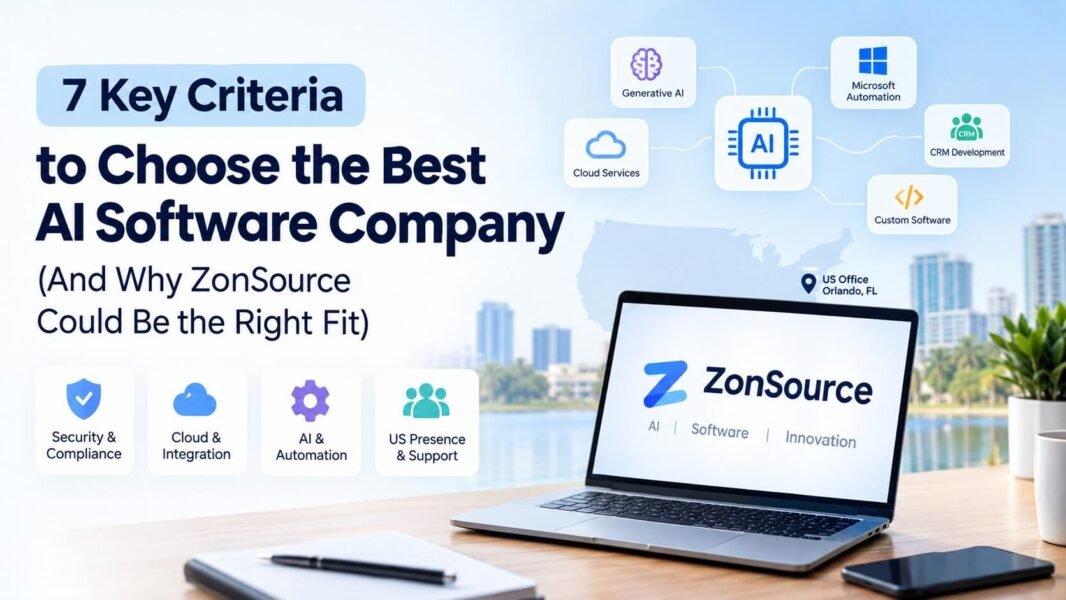
So what makes the best AI software company for your business? It isn’t the loudest marketing or the longest service list. It is the partner that fits your size, industry, risk profile, and existing tools. This guide gives you seven practical criteria for judging any vendor. It then looks at ZonSource, an AI and custom software company with a US office, so you can decide whether it deserves a spot on your shortlist.
Why choosing an AI partner is harder than it looks
Two years ago, “AI development” meant a narrow set of machine learning projects. Today it covers generative AI, retrieval-augmented generation (RAG), autonomous agents, workflow automation, and AI features inside CRMs and Microsoft 365. The label is broad, and quality varies a lot.
Most failed AI projects share the same causes. The pilot never connected to real company data. Nobody planned for permissions, security, or compliance. The demo worked but the system couldn’t scale. Or the vendor disappeared after launch. A good partner prevents these problems before they start.
The 7 criteria that actually matter
1. A record of shipping to production
Proofs of concept are easy. Production systems with real users are not. Ask for live examples, the size of the user base, and what changed for the client after launch. A vendor with years of delivery behind it has usually seen the failure modes already.
2. Security and compliance maturity
For US businesses in healthcare, finance, or any sector handling customer data, security is a requirement, not an add-on. Look for recognized certifications such as ISO 27001 and an understanding of rules like HIPAA. Ask how your data is handled, whether it is ever used to train third-party models, and how access is controlled.
3. Comfort working with US teams
Time zones, communication habits, contracts, and legal expectations all matter. A partner with a US presence and experience with American clients often removes friction that would otherwise slow your project.
4. Ability to work with your existing systems
Very few companies start from a blank slate. You likely run a CRM, a Microsoft environment, older internal software, and cloud infrastructure. The best AI partner integrates with all of it instead of asking you to replace everything.
5. A transparent process
You should know what happens in week one, who you talk to, and how progress is shown. Look for scoped discovery, regular demos, and visible dashboards. Vague timelines are a warning sign.
6. Clear engagement and pricing models
Ask whether the work is fixed-scope or time-and-materials, and what is excluded. AI projects often hide ongoing costs, such as usage-based model fees. A trustworthy vendor explains those costs early.
7. Support after launch
AI systems drift, data changes, and models get updated. Make sure the vendor offers iteration, monitoring, and support once the project goes live.
Where ZonSource fits

ZonSource positions itself as an AI software development company that has been operating since 2012. The details below come from the company’s own website, so treat them as claims to verify during your evaluation.
Services
The company organizes its work into six practices:
- Generative AI development: consulting, custom models, LLM fine-tuning, AI agents, chatbots, system integration, and enterprise automation.
- Microsoft automation: Power Apps, Power BI, Power Automate, Office 365, SharePoint, and Copilot integration.
- CRM development: Salesforce, HubSpot, Zoho, custom CRMs, plus integration and data migration.
- Enterprise software: custom applications, APIs, SaaS products, and legacy modernization.
- Cloud services: architecture, migration, and DevOps.
- Quality engineering: automated testing, performance and security testing, and AI model validation.
This breadth lines up with criterion 4. A business that wants AI inside its CRM, its Microsoft environment, and a modernized legacy app can talk to one team instead of three.
Track record
ZonSource says it has served 180+ teams across 12 countries and shipped 300+ products. Its portfolio lists US-facing brands across several industries, including pet insurance, travel nurse staffing, outdoor media, pool supplies, and a private social club. One healthcare case on its site describes a HIPAA-grade portal delivered in about 11 weeks, with support tickets reported down 62%. These are company-reported figures, so ask for references before relying on them.
Security
The site displays ISO 27001 and ISO 9001 certification badges. For regulated industries, that is a reasonable starting point for a deeper security conversation, though you should still request the current certificates and details of how they apply to your project.
Process
ZonSource describes a four-stage approach: discovery and scoping, a kickoff with architecture review, build in two-week sprints with demos, and then launch and ongoing operation. It promises onboarding in under two weeks and says new prospects get a short written take and a fixed-scope plan within 48 hours of sharing a brief. If that holds up in practice, it speaks directly to criteria 5 and 6.
US presence
The company lists a US office in Orlando, Florida, alongside offices in India and Australia. Its engineering is based largely offshore, so ask how overlap with US working hours, handoffs, and escalation are managed.
Who ZonSource is best suited for
Based on what the company publishes, it looks most relevant to:
- Mid-market US companies that need AI added to existing CRM, Microsoft, or cloud systems.
- Healthcare, fintech, retail, manufacturing, and SaaS firms, which are the industries it highlights.
- Teams with aging software that want gradual modernization instead of a risky full rewrite. ZonSource describes using the strangler-fig pattern, which replaces a system piece by piece while the business keeps running.
- Product companies that need a senior team to build an AI-native feature or an entire SaaS product.
It may be less suited to businesses wanting a purely local, on-site team, or to very small projects where a freelancer or off-the-shelf tool would be cheaper. Be honest with yourself about scope before you reach out.
Questions to ask ZonSource, or any AI vendor
Before signing anything, put these to every company on your shortlist:
- Can you show two live systems similar to mine, and may I speak to those clients?
- Where will my data be stored and processed, and is it ever used to train models?
- Who exactly will work on my project, and what is their experience?
- What is included in the quoted price, and what ongoing costs (model usage, hosting, support) should I expect?
- How do you test AI output for accuracy, bias, and security before launch?
- What happens after launch, and what does support cost?
- How do you handle time-zone overlap with my team?
Vendors that answer clearly and without defensiveness are usually the ones worth hiring.
How to get started
Start small and specific. Write a one-page brief describing the business problem, the systems involved, the users, and what success looks like. Share it with two or three vendors, ZonSource among them if it matches your needs. Compare their written responses, not just their sales calls. You can reach ZonSource through the contact page on its website, or browse its services first
Final thoughts
There is no single best AI software company for every US business. The best choice is the one with proven production experience, real security practices, smooth integration with your current tools, and a transparent way of working. ZonSource’s mix of generative AI, Microsoft, CRM, enterprise software, and cloud services, plus its US office and published process, makes it a credible name to evaluate. Do your own due diligence: ask for references, check certifications, and run a small paid pilot before committing to a large contract.

Sign in to share your opinion
Sign in with Google