
 princedigital44@gmail.com
How to Choose Between Two Great Options: A Simple Decision-Making Framework
Choosing between two bad options is easy — you just pick the lesser evil. Choosing between two good options is where people actually get stuck. There’s no obvious wrong answer to eliminate, which is exactly what makes it so uncomfortable.
This guide gives you a step-by-step framework for breaking that kind of tie, backed by decision-science research rather than gut-feeling advice.
By GuessPick · Reading time: ~9 minutes
of people report frequent difficulty making decisions, and 68% say it measurably affects their work performance when the difficulty is severe.
Source: Oroian et al., European Psychiatry, 2025
Table of Contents
- Why “Two Great Options” Is Harder Than It Sounds
- Step 1: Separate the Decision From the Anxiety
- Step 2: Build a Weighted Scoring Table
- Step 3: Apply the 10-10-10 Rule
- Step 4: Use Regret Minimization
- Step 5: Run the Reversibility Test
- Which Framework Should You Use? (Decision Table)
- When “Good Enough” Beats “Perfect”
- Frequently Asked Questions
Why “Two Great Options” Is Harder Than It Sounds
It feels like having two good choices should be a lucky problem. Research on choice overload suggests otherwise: choice overload, also known as overchoice or the paradox of choice, describes how people get overwhelmed when presented with multiple options — and studies consistently find people have a harder time choosing from a larger array of options than they’d expect. The same mechanism applies with just two options when they’re closely matched — your brain treats “equally good” as “equally risky to get wrong.”
This isn’t just discomfort in the moment. It has a measurable cost:
of adults with frequent decision difficulty say it significantly affects their work performance — and the effect compounds with every decision you’re carrying at once.
Source: Oroian et al., European Psychiatry, 2025
of U.S. adults have experienced buyer’s remorse after an online purchase, with the top causes being poor fit and insufficient research beforehand — not necessarily a bad option.
Source: Slickdeals/OnePoll survey, 2022
The takeaway: when two options are close, the process you use to decide matters more than finding some hidden “correct” answer — because with two great options, there often isn’t one.
Step 1: Separate the Decision From the Anxiety
Before comparing Option A and Option B, get honest about what’s actually causing the stuck feeling. Decision paralysis is the result of cognitive overload and fatigue when someone faces a situation where they’re unable to single out between options — and it’s driven as much by fear of regret as by the options themselves.
Ask yourself:
- Am I actually torn, or am I afraid of being wrong?
- Is there a deadline forcing urgency, or am I stalling?
- Would a friend in my exact position see this as a hard decision, or am I overweighting it?
If the anxiety is bigger than the actual stakes, that’s useful information on its own — it tells you the framework below matters more for your peace of mind than for the outcome, since either option is likely to work out fine.
Step 2: Build a Weighted Scoring Table
The single most reliable tie-breaker for two close options is a weighted decision matrix. It works because it forces you to make your criteria and their relative importance explicit, instead of comparing options against a fuzzy, shifting mental checklist.
How to build one:
- List every criterion that actually matters to you (cost, time, quality, risk, etc.)
- Assign each criterion a weight from 1–5 based on how much it matters
- Score each option on each criterion from 1–5
- Multiply score × weight for each row, then total the columns
| Criterion | Weight (1–5) | Option A Score | Option A Total | Option B Score | Option B Total |
|---|---|---|---|---|---|
| Cost | 4 | 4 | 16 | 3 | 12 |
| Long-term value | 5 | 3 | 15 | 5 | 25 |
| Time to implement | 3 | 5 | 15 | 2 | 6 |
| Risk if it goes wrong | 4 | 3 | 12 | 4 | 16 |
| Total | 58 | 59 |
The point isn’t that the higher number “wins” automatically — it’s that building the table forces you to notice, for example, that Option A only loses because you weighted “long-term value” heavily. If that weight feels wrong once you see it in black and white, that’s useful signal to adjust it, not a flaw in the method.
Step 3: Apply the 10-10-10 Rule
Popularized by former Harvard Business Review editor Suzy Welch, the 10-10-10 rule reframes a decision across three time horizons:
- 10 minutes: How will I feel about this choice ten minutes from now?
- 10 months: How will I feel about it ten months from now?
- 10 years: Will this decision even matter in ten years?
This is especially useful for options where one feels more exciting right now but the other holds up better over time — a common trap when comparing a flashy option against a steadier one. If an option only wins on the 10-minute view, that’s a warning sign, not a green light.
Step 4: Use Regret Minimization
The regret-minimization framework — famously used by Jeff Bezos to decide whether to leave a stable job and start Amazon — asks a single question: “When I’m 80, which choice will I regret not making?”
This works well specifically for two-great-options scenarios because it sidesteps the trap of trying to predict which option performs “better” on paper. Instead, it asks which absence you could live with. Buyer’s remorse research backs this up indirectly: common reasons people regret a purchase include impulse buying, not doing proper research, and not bothering to compare prices or options — not simply picking the “wrong” option among good ones. In other words, most regret comes from how you decided, not which of two solid options you picked.
Step 5: Run the Reversibility Test
Amazon’s own internal decision-making framework separates choices into one-way doors (hard or impossible to reverse) and two-way doors (easy to undo). Before agonizing further, ask:
- If I pick wrong, can I switch later without major cost?
- What would it actually take to reverse this — money, time, relationships?
If it’s a two-way door — a subscription you can cancel, a tool you can swap, a product you can return — the “right” answer matters far less than you think, and you should decide faster and correct course later if needed. Save the heavy deliberation for genuine one-way doors.
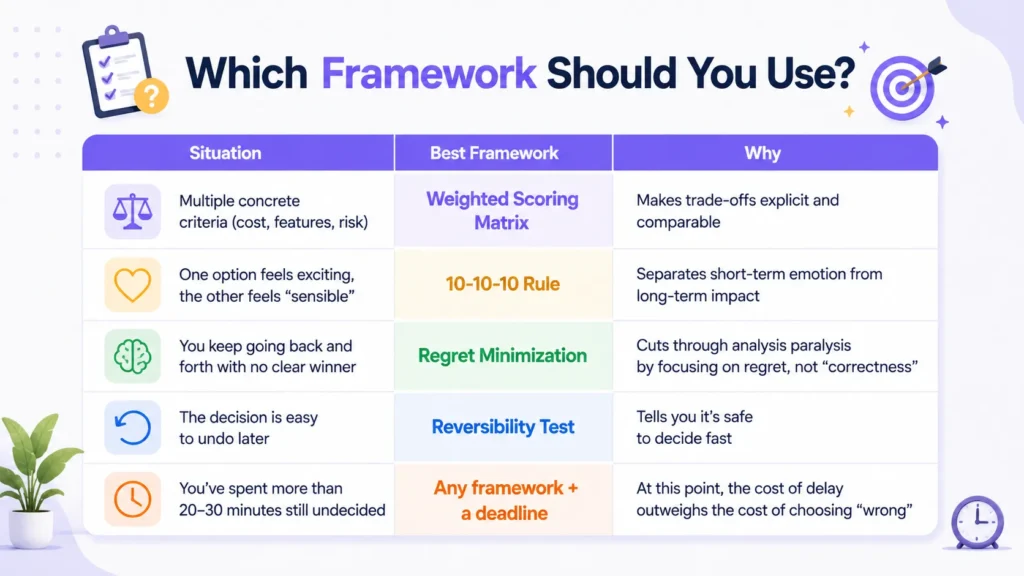
Which Framework Should You Use? (Decision Table)
| Situation | Best Framework | Why |
|---|---|---|
| Multiple concrete criteria (cost, features, risk) | Weighted Scoring Matrix | Makes trade-offs explicit and comparable |
| One option feels exciting, the other feels “sensible” | 10-10-10 Rule | Separates short-term emotion from long-term impact |
| You keep going back and forth with no clear winner | Regret Minimization | Cuts through analysis paralysis by focusing on regret, not “correctness” |
| The decision is easy to undo later | Reversibility Test | Tells you it’s safe to decide fast |
| You’ve spent more than 20–30 minutes still undecided | Any framework + a deadline | At this point, the cost of delay outweighs the cost of choosing “wrong” |
When “Good Enough” Beats “Perfect”
Psychologist Barry Schwartz distinguishes between “maximizers” (who compare every possible option to find the objectively best one) and “satisficers” (who set a “good enough” bar and choose the first option that clears it). Research on choice overload consistently finds that decision fatigue is linked to poorer decision quality overall, and fatigue effects are stronger the more decisions a person has already made that day — which means the more you deliberate past a certain point, the worse your judgment actually gets, not better.
If you’ve already run one of the frameworks above and the two options are still nearly tied, that’s not a sign to analyze further — it’s a sign that you’ve reached the point where either choice is genuinely fine, and continued deliberation is costing you more than a “wrong” choice would.
Frequently Asked Questions
What’s the fastest way to decide between two good options?
Run the reversibility test first. If the decision is easy to undo (a two-way door), pick based on gut instinct and move on — the cost of a slow decision is often higher than the cost of switching later if needed.
Is it bad to spend a long time deciding between two choices?
Past a certain point, yes. Research on decision fatigue shows judgment quality declines the longer and more often you deliberate in a single stretch, so extended back-and-forth on a close call can lead to a worse outcome than deciding sooner with a clear framework.
What is the 10-10-10 rule for decision-making?
It’s a framework that asks how you’ll feel about a decision in 10 minutes, 10 months, and 10 years, helping separate short-term emotional pull from long-term consequences — useful when one option feels more exciting now but the other holds up better over time.
How do I stop overthinking a decision between two similar options?
Set a firm deadline before you start comparing, use a weighted scoring matrix to make your criteria explicit, and accept that if the scores end up close, either option is likely to work out — the anxiety of choosing “wrong” is usually bigger than the actual gap between two good options.
What is regret minimization in decision-making?
It’s a framework — popularized by Jeff Bezos — that asks which choice you’d regret not making when looking back from much later in life. It’s especially useful for two-great-options scenarios because it shifts the question from “which is objectively better” to “which absence could I live with.”
Summary
Two great options feel harder to choose between than one good option and one bad one, because there’s no obvious elimination to lean on — and that ambiguity is exactly what decision fatigue research says makes people stall. Rather than waiting for a “correct” answer to reveal itself, use a structured framework: score the options against weighted criteria, check how you’ll feel about the choice across different time horizons, ask which one you’d regret skipping, and confirm whether the decision is even hard to reverse in the first place. In most two-great-options situations, the framework you use to decide matters more than which option you end up picking.
Weighing specific products instead of an abstract decision? Browse our Compare section for direct head-to-head breakdowns, check Reviews for in-depth testing, or read more Guides on making smarter choices.
Sign in to share your opinion
Sign in with Google